August 2026 Newsletter
County and City "Penny Tax" Initiatives to Be Featured At the Next Neighborhood Association Meeting on August 19th
Mark Your Calendars - the next Haynie-Sirrine Neighborhood Association meeting is Wednesday, August 19th at the Next Innovation Center from 6:00 to 7:00 pm. The meeting will focus on the County and City "penny tax" initiatives. Greenville County Council District 23 representative Alan Mitchell will provide an overview of the Greenville County "transportation penny tax" referendum, and Greenville City Council At-Large representative Dorothy Dowe will present information about the Greenville City "penny tax" initiative. This is an opportunity for our neighborhood to learn more about these important tax initiatives and ask our elected representatives questions.
The neighborhood meeting will also include an update from the City of Greenville's Cameron Campbell on the Urban Forest Comprehensive Plan, the City's first-ever urban forest plan. The plan is aimed at building a 20-year plan for the care and stewardship of Greenville's urban forest.
Wednesday, August 19th, 6:00 – 7:00 PM
NEXT Innovation Center, 411 University Ridge
The following are summaries of the County and City "penny tax' initiatives. We apologize upfront for the length of these summaries, but we feel that it is important that this information be made available to the neighborhood. There has been recent media coverage of the "penny tax" initiatives, and the City hosted a public meeting on July 28th to provide information about the City "penny tax". We have attempted to summarize this information in this newsletter, and we will be providing additional "penny tax" information in subsequent newsletters.
Greenville County "Transportation Penny Tax" Referendum
In addition to the statewide 6% sales tax, South Carolina law permits individual counties to impose additional local sales taxes if the voters in that county approve the tax through a referendum. Under state law, each type of these local sales taxes has its own restrictions and specifications, and is limited to no more than 1% of gross sales. These 1% local sales taxes are often referred to as 'penny taxes" since the additional tax generates 1 cent of tax revenue for every 1 dollar of sales. State law also requires that a local "penny tax" must be enacted for a set number of years, and must be approved through a county-wide public referendum.
On July 21st Greenville County Council approved by an 8 to 3 vote to enact an ordinance to levy and impose a 1% transportation sales and use tax, subject to approval via a county-wide public referendum on November 3rd. This "transportation penny tax" is a specific type of local sales tax permitted under South Carolina law. The "transportation penny tax" can be up to 1% and is imposed specifically for transportation-related projects such as highways, roads, streets bridges, and related drainage facilities. The "transportation penny tax" revenue can also be for financing the costs of mass transit systems, and for financing the costs of "greenbelts".
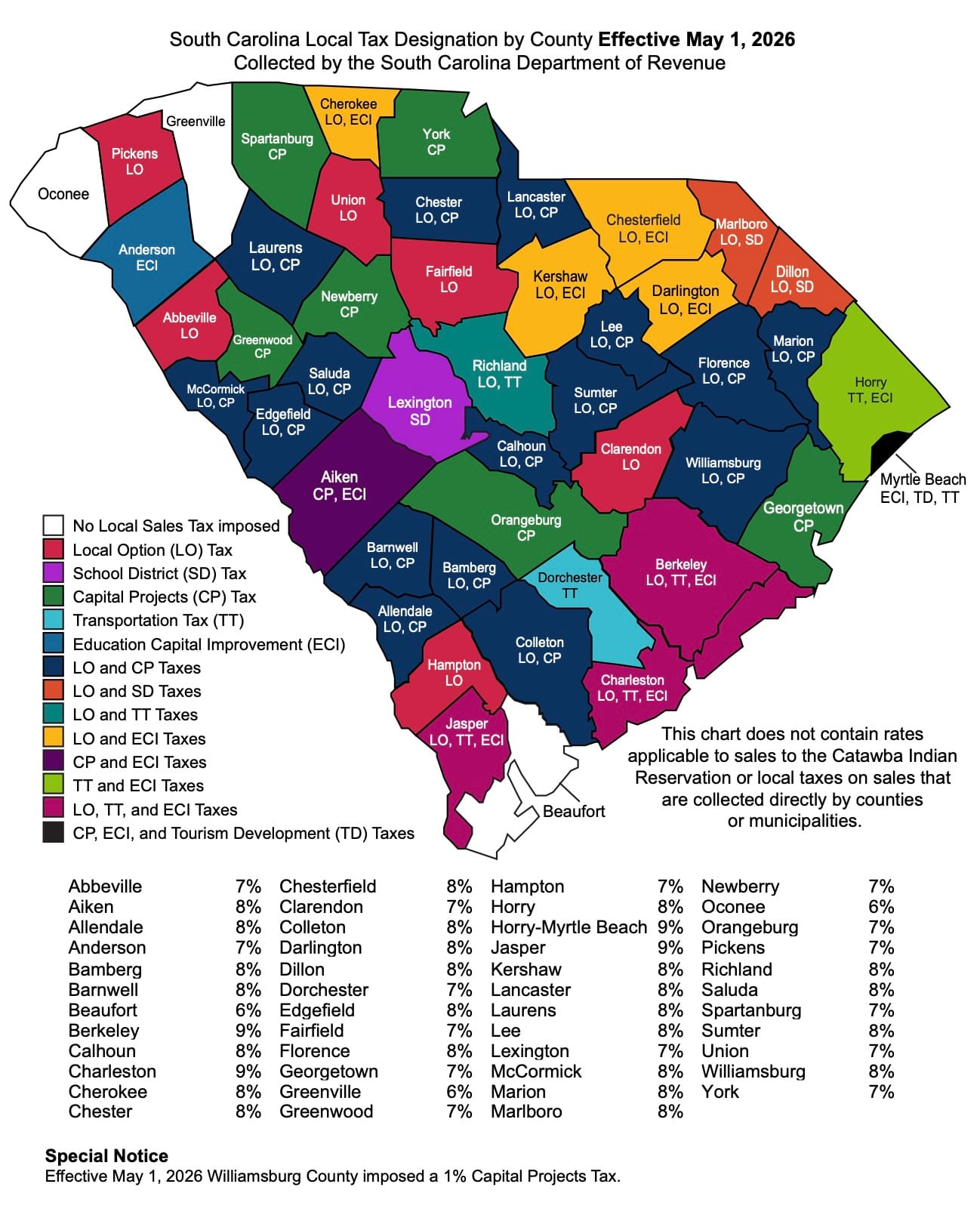
Of South Carolina's 46 counties, all but three have enacted some form the local "penny tax", with some counties enacting more than one type of local "penny tax". The only counties that have not enacted a local "penny tax" are Beaufort, Greenville and Oconee. Below is a depiction of the local "penny tax" designations by county, as well as the total overall sales and use tax rates for each county (Note - as previously mentioned, the statewide sales and use tax rate is 6%):
Greenville County is the largest county in South Carolina by population and employment, and is also home to the largest roadway system in the state. The County's proposed "transportation penny tax" is the third attempt by County officials to get a local "penny tax" approved by county voters in order to address a backlog of road, bridge and infrastructure requirements and improvements. In 2014 county voters rejected a proposed 1% local sales tax referendum by a wide margin. In 2024, a similar "County Capital Projects Sales Tax" that would have generated an estimated $1 billion over eight years was also rejected by voters, but by a much closer margin (51.5% opposed, 48.5% in favor) than the 2014 vote.
Key elements of the County "transportation penny tax" referendum include the following:
- State Law - The County "transportation penny tax" is proposed pursuant to Chapter 37 of the SC Code of Laws - specifically, Section 4-37-30, Sales and Use Taxes or Tolls As Revenue for Transportation Facilities
- Referendum - The County "transportation penny tax" referendum will be subject to a county-wide vote on November 3rd
- Effective Date - If approved by the county-wide vote, the County "transportation penny tax" would be effective on May 1st, 2027
- Duration of Tax - The County "transportation penny tax" would be imposed for 8 years
- Sales Tax Application - the 1% County "transportation penny tax" would apply to sales within Greenville county
- County "Penny Tax" Exemptions - Under state law, certain items such as gasoline, most groceries, and prescription medications would be exempt from the County "transportation penny tax"
- Tax Revenue - The County has estimated that $1.1 billion in revenue would be generated by the County "transportation penny tax" over the 8 year period. The adopted ordinance states that the funding of projects from the "penny tax" will not exceed $1.1 billion
- Uses of Tax Revenue - State law requires that revenue generated by a "transportation penny tax" be primarily used for roads, bridges and other transportation infrastructure. However, the law does permit "transportation penny tax" revenue to also be allocated to fund "greenbelts" and "mass transit"
- Revenue Use Allocation - Pursuant to the law, County Council has determined that 90% (up to $990 million) of the estimated revenue would be used for the cost of roads, streets, bridges, and other transportation-related projects, with 7% (up to $77 million) allocated to the expansion of green spaces and land preservation, and 3% (up to $33 million) to the operations and expansion of mass transit (Greenlink)
- Municipal Allocation of "Transportation Penny Tax" Revenue - Since the County "transportation penny tax" revenue will be generated across the entire county, the revenue allocation for transportation infrastructure (up to $990 million) will be allocated annually to the area municipalities on a "pro-rata" basis based on the county "transportation penny tax" revenue generated within the municipality
- Transportation Infrastructure Project Planning - The County "transportation penny tax" does not require the public listing of infrastructure projects to be funded by the "penny tax" revenue. The County has conducted studies and analysis of Greenville County's infrastructure needs, and have also received input from the municipalities in the area. The County will use this information to finalize a transportation infrastructure investment plan
- An important point of clarification - state law does NOT permit the use of "transportation penny tax" revenue for property tax relief. Consequently, the County "transportation penny tax" referendum does not provide for property tax relief for homeowners in Greenville county. There has been some previous misinformation about this item in the local media coverage.
If the County "transportation penny tax" is approved by voters on November 3rd, County Council would establish a Transportation Transparency Committee comprised of at least six members to be appointed by County Council. The Committee would be responsible for reviewing appropriations and expenditures of the "penny tax" revenues to ensure that the revenues are appropriated and used in accordance with state law and the "penny tax" ordinance.
City of Greenville "Penny Tax" and the Municipal Tax Relief Act
Until this May, state law allowed only counties to put forward local sales and use tax (such as a 1% "penny tax") referendums for voter approval. Municipalities such as the city of Greenville were not authorized to consider their own local "penny tax" initiatives. As previously mentioned, Greenville County is one of only three South Carolina counties (out of 46) that have not enacted a county local sales and use tax. The most recent county-wide "penny tax" referendum in 2024 was narrowly defeated by the overall county vote. However, with the 2024 referendum the majority of voters in the city of Greenville actually voted in favor of the County "penny tax". In other words, in 2024 the overall county vote was opposed to the County"penny tax", but the majority of voters in the city were in favor of it.
Following the 2024 county-wide referendum, Greenville City leaders began working with our state legislative representatives to develop legislation that would allow South Carolina cities that are located in counties that have not imposed a county "penny tax" to pass their own local sales and use ordinances and put forward "penny tax" referendums for voter approval. The result of these efforts is the Municipal Tax Relief Act that was signed into law in May. This legislation was sponsored by Greenville State Senators Jason Elliott and Ross Turner. This law now allows municipalities such as Greenville, which reside in counties that have not enacted a county "penny tax", to pursue their own 1% local sales and use tax within their municipality - a city "penny tax".
The Municipal Tax Relief Act limits the use of the City "penny tax" revenue to the construction, repair, and improvement of local roads, bridges, and drainage systems, and supportive capital projects such as police facilities, fire stations, public assembly building facilities and emergency response buildings. The Act also provides for property tax relief. The Act requires that 20% of the revenue generated by the city "penny tax" must be used to provide a credit against a taxpayer's municipal property taxes on owner-occupied property.
The City of Greenville has now taken the first steps to implement its own City "penny tax" initiative. It is important to note that the County and City "penny tax" initiatives are governed by two distinct and separate state laws. The County "transportation penny tax" is authorized by Chapter 37 of South Carolina Code of Laws, while the City "penny tax" is authorized by Chapter 41 - the Municipal Tax Relief Act. The key elements of the proposed City "penny tax" are the following:
- State Law - The City "penny tax" is proposed pursuant to Chapter 41 of the South Carolina Code of Laws - the Municipal Tax Relief Act
- Referendum - If approved by City Council, the City "penny tax" referendum would be subject to a city-wide vote on November 3rd
- Effective Date - If approved by the city-wide vote, the City "penny tax" would be effective on May 1st, 2027
- Duration of Tax - Under the Act, the City "penny tax" ends automatically at the end of 8 years
- Sales Tax Application - The 1% City "penny tax" would apply to sales within the city limits
- City "Penny Tax" Exemptions - Under state law, certain items such as gasoline, most groceries, and prescription medications would be exempt from the City "penny tax"
- Tax Revenue - The City has estimated that approximately $511.6 million in revenue would be generated by the City 'penny tax" over the 8 year period.
- Property Tax Relief - Under the Act, 20% of the projected City "penny tax" revenue must be used for annual property tax credits for owner-occupied residences in the city of Greenville. The City estimates that approximately $102.3 million will be used for property tax relief over the 8 year period. Note - the credit that property owners receive each year would vary based on how much revenue is generated each year by the City "penny tax"
- Infrastructure Investment - With the remaining 80% of the projected revenue, approximately $409.2 million, the City would fund over 500 infrastructure projects over 8 years
- Uses of Tax Revenue - The City "penny tax" has fairly strict limits on the uses of the tax revenue. The uses of the funds are limited to specific capital projects such as roadway improvements, sidewalks, stormwater infrastructure and public safety buildings. Unlike the County "penny tax", the City "penny tax" revenue cannot be used for a wider variety of purposes such as land preservation and mass transit
- Projects List - Under the Act, the City must publicly list the capital projects and the associated costs before the referendum vote. As previously mentioned, the County "transportation penny tax" does not have a requirement to list the county projects as part of the referendum vote
- Projects List Information - The City has developed a proposed list of projects following detailed study and analysis. The project list represents a comprehensive infrastructure plan that is focused on neighborhoods and the overriding goals of the GVL 2040 comprehensive plan. You can access this project list, and learn more about the City "penny tax", via the following link:
https://www.greenvillesc.gov/municipal-tax-relief-act
Next Steps - In order to move forward to a November referendum, City Council must adopt an enacting ordinance with the finalized project list and cost estimates by August 14th. City Council unanimously approved the proposed ordinance at first reading on July 13th. The second and final reading of the ordinance, including the final project list, is scheduled for August 10th. If approved by City Council at second reading, the project list as adopted cannot be altered before the November 3rd city-wide referendum. If the referendum is approved by City voters, the accompanying project list can only be changed through a City Council approved ordinance.
What Happens If Both the County and City "Penny Tax" Referendums Are on the November 3rd Ballot?
If Greenville City Council approves the City "penny tax" ordinance at second reading on August 10th, both the County and City "penny tax" referendums will be on the November 3rd ballot. All eligible voters in Greenville County will vote on the County "penny tax" referendum. Eligible voters who reside within the Greenville city limits would vote on both the County and City "penny tax" referendums. This would not be an "either or" vote. City voters would be able to vote in favor of one, or both, of the referendums, or not not favor of either. The following outcomes are possible:
- County "penny tax" approved, City "penny tax" not approved - If the county-wide vote approves the County "penny tax", and the City "penny tax" is not approved by the city-wide vote, the County "penny tax would go into effect on May 1st. The 1% County "penny tax" would be applied to sales throughout the County, including those within the city. The City "penny tax", including the property tax relief, would obviously not go into effect.
- County "penny tax not approved, City "penny tax" approved - If the county-wide vote does not approve the County "penny tax", and the City "penny tax" is approved by the city-wide vote, the County "penny tax" would not go into effect. The City "penny tax", including the property tax relief, would go into effect on May 1st. The 1% City "penny tax" would be applied to sales within the city, and the property tax relief would apply only to homeowners within the city limits.
- Both County "penny tax" and City "penny tax" approved - If the county-wide vote approves the the County "penny tax" referendum, and the city-wide vote approves the City "penny tax" referendum, both "penny taxes" would go into effect on May 1st. The 1% County "penny tax" would be applied to sales throughout the county, including those within the city. In addition to the 1% County "penny tax", the 1% City "penny tax would also be applied to sales within the city. In other words, a total of an additional 2% in "penny taxes" would be applied to sales with the city limits. The property tax relief would also go into effect but would apply only to homeowners with the city limits.
- Both County and City "penny taxes" not approved - If both "penny tax" referendums are not approved by voters on November 3rd, neither "penny tax" will go into effect.
Learn More About the County and City "Penny Tax" Initiatives At the August 19th Neighborhood Meeting
The County and City "penny tax" initiatives provide an opportunity to address the Greenville area's long-standing infrastructure needs. These are critically important initiatives. We encourage you to attend our August 19th meeting to learn more and discuss these initiatives with our elected officials. We hope to see you on August 19th.